Whether you’re tackling a construction or DIY project, a big debate can be over which fastener to go for. Use the wrong one, and you could end up with weak joints, damaged materials, or a structure that doesn’t hold up over time.
That’s why we’re here to help.
Whether you’re building a deck, putting furniture together, or installing plasterboard, knowing when to use nails or screws will save you time, money, and headaches.
In this guide, we break down the key differences between screws and nails and look at which is the best option for certain projects.
What are screws?
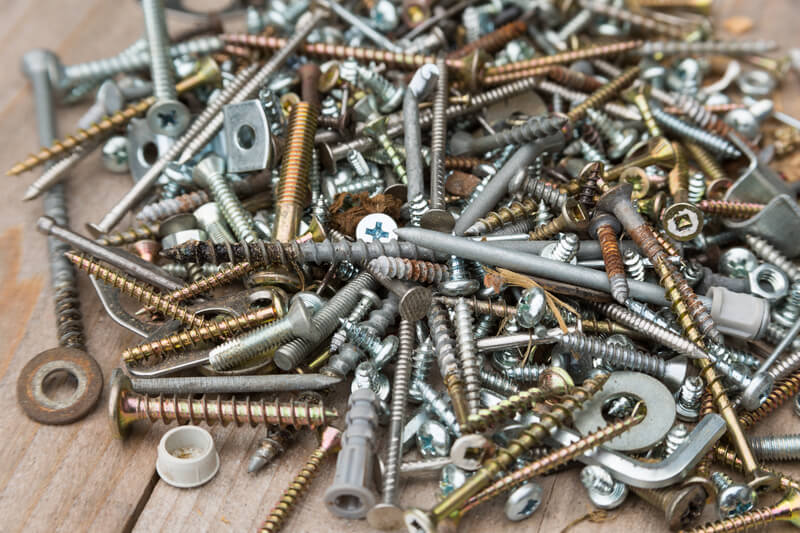
Screws are fasteners with threads designed to hold materials together. Screws can be used precisely and give strong holding power. They come in a variety of head shapes, such as flat, round, or Phillips. Plus, you can buy them in a selection of different materials depending on the job you have.
What are nails?
Nails are slender metal shafts with pointed tips and flattened heads. They are used to join materials by being driven into them, usually with a hammer or nail gun. You’ll usually find them made of steel, but they are available in aluminium and brass.
Key difference between screws and nails
While both nails and screws are used to fasten materials, their design means they have different strengths.
Materials and construction
Both fasteners are typically made from steel, brass, and galvanised options, all of which offer strength and resistance.
Galvanised coatings help against corrosion, making them ideal for use outdoors. Stainless steel protects against rust, and brass designs are used for aesthetic purposes.
Holding power and strength
Screws have exceptional gripping strength, which is down to their threaded design. This makes them the ideal choice for jobs where components could be pulled apart.
The strength of nails and their design means they’re better able to withstand forces that might cause materials to slide past each other.
Ease of use
When it comes to ease of use, nails often have the upper hand. You can easily drive them into materials using a hammer or a nail gun. Ideal if you’ve got a big project and a tight time frame.
Screws take a little longer, especially when you’re using a manual screwdriver.
Flexibility and removal
A big advantage of screws is the fact that they can be removed without causing damage. This means that you can make changes to disassemble the items if needed.
Nails, on the other hand, are harder to extract, and you’ll likely damage them and the item when removing them. This is more likely to happen if they’ve been in place for a while, too.
Best uses for screws
Screws are ideal for:
- Woodwork and cabinetry: Their strong holding power ensures joints remain tight over time.
- Decking: Screws will securely attach deck boards, preventing them from loosening.
- Drywall installation: Screws minimise the risk of popping, giving a firm hold.
- Fixtures and hardware: Their precision makes them perfect for mounting brackets, hinges, and other hardware.
Best uses for nails
Nails are best suited for:
- Framing and structural work: They have flexibility, which means they can move without breaking.
- Sheathing and subflooring: Nails will hold in place while wood naturally expands and contracts.
- Exterior siding and roofing: Nails are great for these, as they’re quickly applied and can withstand the forces of wind and weather.
- Finish carpentry: Thin nails are ideal for use to avoid the splitting of delicate trims and moulding.
Nails or screws for fence
When building a fence, the choice between nails or screws depends on the priorities. Nails are less expensive and can be quickly installed, ideal for bigger projects. However, screws give a stronger and more durable hold, reducing the chance of the boards loosening over time.
Get a balance between speed and longevity by using nails for the main structure and then screws to attach the fence boards.
Nails or screws for framing
Nails are best for framing construction, as they’re flexible and can withstand strong forces. They will bend when under pressure without snapping, which is crucial for structural applications.
What’s more, nails can be quickly driven with a nail gun, an efficient choice for large-scale projects.
Screws may give tensile strength, but they’re more brittle and can shear off under heavy loads, which makes them less suitable for framing.
Screws or nails for floorboards
To secure floorboards, screws are typically the better choice over nails. They give a tighter hold. This means they’re less likely to loosen over time, and it minimises the chance of squeaking. Screws also give you the ability to easily remove and replace the boards if needed.
It is possible to use nails for floorboards, but they may come loose as the wood naturally moves, which could result in gaps and noise.
Screws or nails for stud wall
When constructing stud walls, nails are the better option because they can handle strong forces and are flexible. They allow for slight movements without the structural integrity being compromised.
However, screws can be used, especially in situations where additional holding power is needed or when you’re working in tight spaces where you can’t hammer. In these cases, use screws that are designed for structural applications for safety and durability.
Nails or screws for plasterboard
If you’re attaching plasterboard (drywall), screws are typically preferred. This is because they give a stronger hold and reduce the chance of the board pulling away from the studs over time. Screws are less likely to pop back out too, which would cause issues with the surface of the wall.
Nails can be used for plasterboard, but they’re more likely to loosen, especially if there are fluctuations in temperature and humidity.
Nails or screws for hanging pictures
The choice between nails and screws for hanging pictures depends on the weight of the item and the wall material. If you have a lightweight frame, nails should be sufficient.
Heavier pieces will require screws with wall anchors to give better support and reduce the chance of the picture falling.
You should also consider the type of wall you’re putting the picture on. Plaster walls will likely need specialised anchors to provide a secure hold.
Pros and Cons of Screws vs Nails
Screws
| Pros | Cons |
| Excellent hold power | More time-consuming to install |
| Easier to remove and adjust | Typically more expensive |
| Less likely to cause wood to split | Can be brittle under heavy forces |
Nails
| Pros | Cons |
| Faster to install, especially with a nail gun | Less holding strength over time |
| More cost-effective in large projects | Harder to remove without damaging materials |
| Offer flexibility under stress | Can cause wood to split if not used correctly |
Expert recommendations: Which should you choose?
The decision of using nails or screws comes down to the requirements of your project. For structural jobs where you need flexibility and strength, nails are the standout choice.
For tasks when you need strong holding power and precision, like cabinetry and decking, screws are the frontrunner here.
Knowing the pros and cons of each fastener will help you make the right choice for your project.
At ASP, we specialise in high-quality screws that are designed to keep your projects secure for the long haul. Explore our range today and get the right screws for the job.